
Fill up the Form
You will get a call back very soon.

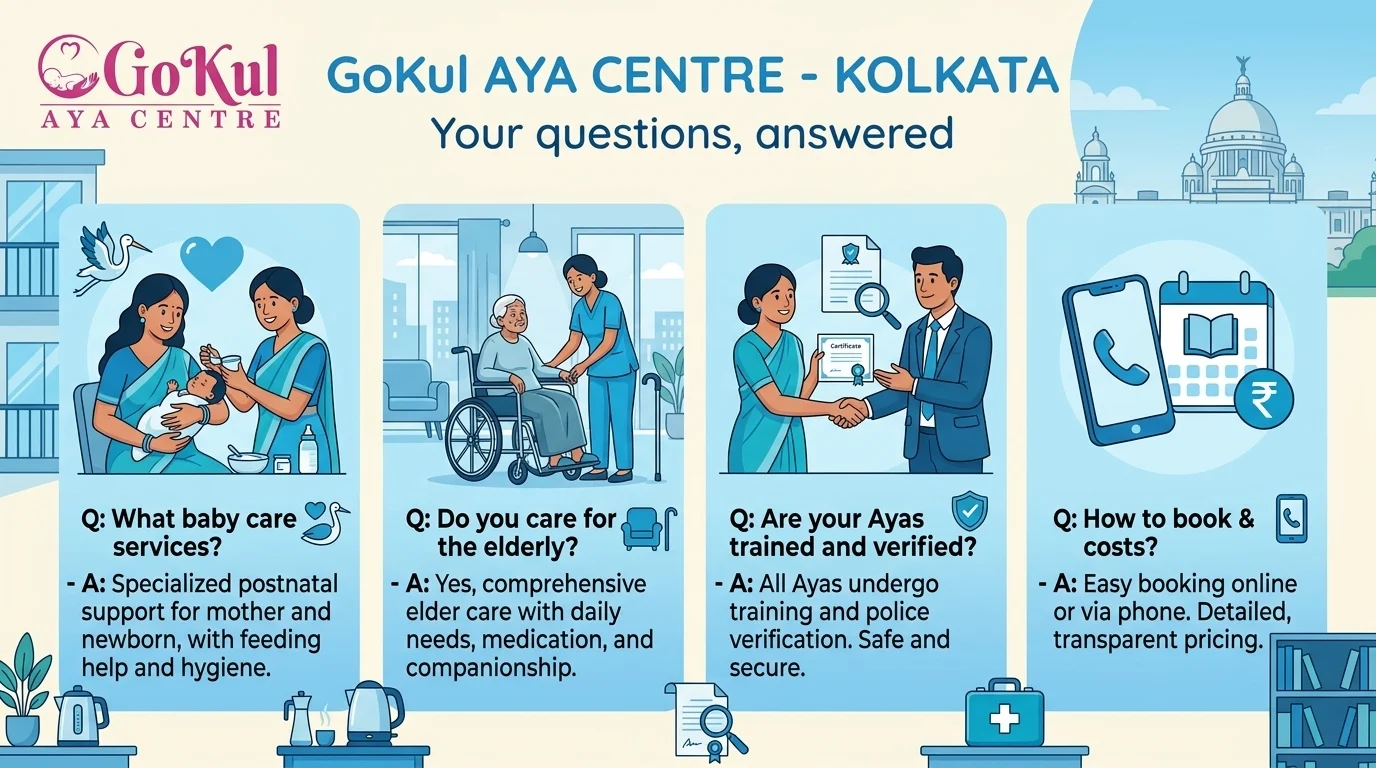
Below are answers to the questions families ask us most, organized into seven sections: understanding the different types of care, our company, our services, where we operate, pricing, the booking process, and verification and trust. If your question isn't covered here, call or WhatsApp us at +91 62917 84442, we're happy to talk it through directly rather than make you dig for an answer.
An aya is the term used across Kolkata and much of India for a home caregiver or attendant, someone who provides non-medical support like daily living assistance, hygiene help, mobility support, and companionship, most often for patients, elderly people, or new mothers and babies. It's a broad, commonly used term, and at Gokul Aya Centre, our ayas are trained and background-verified before placement.
A nurse has formal medical training and can handle clinical tasks like administering medication, monitoring vital signs, and managing wound care or post-surgical recovery. An aya or attendant focuses on non-clinical support, bathing, feeding, mobility, and companionship. Many families start with an aya and add a nurse if medical needs increase, or book a nurse directly when clinical care is the priority from day one.
"Japa" refers to the traditional postnatal recovery period in Bengali culture, generally the first 21 to 40 days after delivery. A Japa maid is a caregiver specifically trained to support a new mother through this period, helping with the baby's early care routine, the mother's recovery, and the practical demands of those first intense weeks. It's a more specialised, time-bound role than general childcare.
A Japa maid is short-term and specific to the postnatal recovery window. A nanny is a longer-term, ongoing childcare role that often starts once the Japa period ends and continues through infancy and beyond. A babysitter tends to be more occasional and flexible, covering specific hours rather than a full daily routine. Many of our families use all three in sequence: Japa maid first, then a nanny, with a babysitter for occasional extra coverage.
A General Duty Attendant (GDA) typically has more formal training aligned with hospital-style patient support, useful for families wanting a slightly higher skill level without a full nurse. Patient care, as we use the term, covers the broader range of at-home recovery support, sometimes provided by a GDA, sometimes by a nurse, depending on what the specific case needs.
Common signs include difficulty with daily tasks like bathing or dressing, missed medication doses, an increase in falls or near-falls, growing isolation, noticeable memory lapses, or a recent hospital stay. If you're noticing any of these, it's worth a conversation, even a part-time daytime attendant can make a real difference before things become urgent.
GDA stands for General Duty Attendant, a caregiver with training closer to hospital-style patient support than a general aya, useful for families who want a step up in skill level without needing a full nurse on staff.
Post-operative home care covers the support a patient needs after returning home from surgery, things like wound monitoring, mobility assistance, medication reminders, and general recovery support, usually provided by a nurse or patient care attendant depending on how involved the recovery is.
Since 2016, founded by Biswajit Nandy, based at 2/135A, Dum Dum Road, Kolkata.
After struggling to find a trained attendant for his own ailing grandfather one difficult night, he decided to build the agency he wished his family had been able to find. Read the full story on our About Us page.
Over 8,000 families since 2016, with more than 2,000 trained caregivers in our network.
Yes, operating since 2016 with a fixed, verifiable address in Dum Dum, Kolkata.
Female and male nurses, elder care, patient care, GDA attendants, baby care, Japa maid service, baby sitters, nannies, and domestic help. See the full list on our Services page.
Yes, for nursing and attendant roles specifically, depending on what the patient is most comfortable with.
Yes, through our Patient Care and Female Nurse or Male Nurse services, depending on the level of medical support needed.
Yes, live-in options exist across nearly every service we provide, nursing, elder care, baby care, Japa maid, and domestic help.
Yes, part-time arrangements are available for most services, particularly domestic help and baby sitting, where a few hours a day is often enough.
Let us know your preference when you call, and we'll do our best to match a caregiver who's comfortable communicating in the language your family needs.
A roughly 7 km radius around Gate No. 1 of Netaji Subhash Chandra Bose International Airport, covering Salt Lake, Dum Dum, Lake Town, Baranagar, Ultadanga, Nagerbazar, New Town, Baguiati, and many surrounding localities. See our full Service Areas page.
Usually within 24 hours for most of our core service area, up to 48 hours for areas further from our Dum Dum base, like New Town.
No, rates depend on the service and shift, not distance. Distance only affects placement timing.
Day shifts typically run ₹400 to ₹900 depending on the service, with monthly live-in packages from roughly ₹8,000 to ₹28,000. See our full Pricing page for a detailed breakdown by service.
Yes, contracts of 30 days or more receive a 5 to 10% discount on the daily rate.
Call or WhatsApp us at +91 62917 84442 or +91 74496 36379, any time. See our full How It Works page for the complete process.
No formal contract is required for most bookings, the arrangement is confirmed verbally before the caregiver starts.
Yes, call us if your needs change, extending, shortening, or switching the type of care is a conversation, not a new application.
Yes, every single caregiver is background-checked and ID-proofed before placement, with no exceptions, and that ID proof travels with them on the job.
We arrange a replacement at no extra cost, this is a standard part of how we operate.
4.8 out of 5 across 37 Google reviews. See our full Reviews page.
Every caregiver goes through background verification and ID proofing before being added to our pool, and many are trained directly using the same approach Biswajit Nandy's mother used when she trained our very first caregivers, patient demonstration, not just a classroom checklist.
Still have a question? Call or WhatsApp us directly, we'd rather talk it through than have you guess.